
Upper Eyelid Surgery in Ottawa
Upper Blepharoplasty: Options and Cost
What is upper blepharoplasty? Upper eyelid surgery, also called an upper eyelid lift, addresses selected excess upper-lid skin and hooding. At an Ottawa consultation, Dr. Sean C. Smith assesses eyelid anatomy, brow position, eye health and your goals before discussing treatment.
Hooded eyelids, low brows or a drooping lid margin? These concerns are not interchangeable. Brow descent can contribute to upper-lid heaviness, while a low eyelid margin may need a different assessment. Dry-eye symptoms, previous eye surgery and difficulty closing the eyes also matter. Ask whether the main concern is excess skin, brow position or another eye condition and whether a brow lift assessment is relevant.
How much does an upper eye lift cost in Ottawa? The published upper blepharoplasty surgical fee estimate is CAD $4,500–$6,500, plus HST. The complete quote depends on the operation, anesthesia and facility requirements, and any combined treatment. Confirm all inclusions, follow-up and additional charges in writing after assessment. Upper and lower eyelid surgery have separate planning and fee considerations.
Is upper eyelid surgery covered by OHIP? Cosmetic eyelid surgery is privately funded. If you have functional or visual concerns, ask about the appropriate medical assessment and referral process. Eligibility for insured care, any approval requirements and availability through the practice must be confirmed separately; appearance alone does not establish coverage.
What should I ask about scars, recovery and risks? Discuss crease incision placement, bruising, swelling, dry eyes, eye closure, asymmetry, vision-related risks and possible revision. Obtain individual instructions for eye care, contact lenses, makeup, work and exercise. Surgery should preserve comfortable eye function as well as address the concern being assessed.
Who may consider upper eyelid renewal?
This procedure may be appropriate for individuals who:
Notice the excess skin of the upper eyelids that creates a heavy or tired appearance
Feel their eyes no longer reflect how they feel internally
Experience visual heaviness or irritation related to eyelid skin
Are seeking subtle, considered improvement rather than dramatic change
Value natural-looking results and restraint
Upper eyelid renewal is not intended for those seeking exaggerated eye shape changes or trend-driven aesthetics.


Our surgical approach
Each upper eyelid renewal plan is developed as a surgical strategy rather than a standardized procedure.
Careful assessment of skin quality, eyelid anatomy, brow position, and facial balance guides every recommendation. In some cases, conservative skin removal alone is appropriate; in others, additional factors may need to be considered. Surgery is recommended only when it meaningfully improves balance and comfort.
Precision and restraint are central to this approach, as even small changes in the eyelids can significantly affect appearance.
What this procedure may address
Upper eyelid renewal surgery may help address:
Excess or lax upper eyelid skin
A heavy or tired appearance of the eyes
Imbalance between the eyes and the surrounding facial features
Functional concerns related to eyelid skin
Every surgical plan is individualized and based on anatomy rather than age or trend.
Frequently Asked Questions (FAQ)
Understanding what upper blepharoplasty actually treats
Upper eyelid aging is often misunderstood as a simple excess skin problem. In reality, the eyelid is a delicate, layered structure, and changes occur differently within each layer over time.
Effective upper blepharoplasty requires understanding how skin, muscle, and fat interact and correcting the right layer with restraint. Treating eyelids as a single-layer issue is one of the most common causes of unnatural-looking results or poor aging.
The three layers of the upper eyelid
Skin: elasticity and drape
Upper eyelid skin is the thinnest skin on the body. With time, it loses elasticity and begins to fold or drape over the lid crease.
Excess skin may:
-
Obscure the natural eyelid crease
-
Create a heavy or tired appearance
-
Interfere with makeup application or vision
Removing skin alone may improve appearance, but only when it is the primary issue.
Muscle: movement and expression
Beneath the skin lies the orbicularis muscle, which controls blinking and contributes to facial expression.
Changes in muscle tone or position can:
-
Affect eyelid shape
-
Contribute to heaviness or hooding
-
Influence how natural the eyes look after surgery
Over-aggressive muscle removal can flatten expression or create stiffness.
Fat: support and softness
Upper eyelid fat provides structure and softness. With age, fat may appear prominent in some areas while diminishing in others.
Fat is often misunderstood as something to be removed.
Excessive fat removal can lead to:
-
A hollow or sunken appearance
-
Premature aging of the eyes
-
An unnatural, skeletal look
Modern upper blepharoplasty emphasizes preservation or repositioning rather than routine removal.
Why one-layer surgery fails
Treating only the skin or removing skin, muscle, and fat indiscriminately ignores the balance required for a natural eyelid appearance.
Common consequences include:
-
Hollow upper eyelids
-
Difficulty closing the eyes comfortably
-
A startled or over-operated look
-
Long-term dissatisfaction
Eyelids demand precision, not maximal correction.
A layered, restrained approach
Dr. Smith approaches upper blepharoplasty as a layer-specific procedure.
Each surgical plan is based on:
-
Skin quality and redundancy
-
Muscle behavior and eyelid movement
-
Fat volume and distribution
-
Overall facial balance
Often, the best result comes from doing less, not more.
Why restraint protects expression
Expression is one of the most important outcomes of eyelid surgery.
By respecting each layer and avoiding over-resection, eyelids retain:
-
Natural movement
-
Softness and character
-
Long-term harmony with the face
Subtle correction preserves identity.
Final perspective
Upper blepharoplasty is not a skin-removal procedure; it is layered eyelid surgery.
By addressing skin, muscle, and fat appropriately and with restraint, Dr. Smith creates results that look natural, feel comfortable, and age gracefully.
A private consultation allows careful assessment of eyelid anatomy and determination of whether upper blepharoplasty is appropriate, without pressure or exaggeration.
-
When the eyelids aren’t the real problem
Many patients seeking upper blepharoplasty believe excess eyelid skin is the primary issue. In reality, what appears to be eyelid heaviness is often influenced, or even caused, by brow descent.
Understanding the difference between true upper eyelid aging and brow position is essential for achieving natural, balanced results and avoiding overcorrection.
How the brow affects the upper eyelids
The eyebrows play a critical role in the appearance of the eyelids.
As the brow gradually descends with age:
-
Skin from the brow pushes downward onto the upper eyelid
-
The eyelid crease becomes less visible
-
The eyes appear heavy, tired, or hooded
-
Removing eyelid skin alone may not fully correct the issue
In these cases, the eyelid responds to changes above it, not failing independently.
True upper eyelid aging
Upper eyelid aging occurs when changes are primarily within the eyelid itself.
This may include:
-
Excess or lax eyelid skin
-
Changes in eyelid crease definition
-
Mild muscle changes affecting the lid position
-
Fat redistribution within the upper eyelid
When eyelid anatomy is the main contributor, upper blepharoplasty alone may be appropriate.
Brow descent masquerading as eyelid excess
Brow descent can create the illusion of too much eyelid skin.
In these situations:
-
Removing eyelid skin risks over-resection
-
The eyes may appear hollow or tight
-
Brow heaviness remains uncorrected
-
Long-term balance may be compromised
Treating the eyelids without addressing the brow may result in unnatural outcomes and patient dissatisfaction.
Why correct diagnosis matters
Choosing the wrong area to correct is one of the most common reasons eyelid surgery looks overdone.
A precise evaluation distinguishes between:
-
Eyelid-driven aging
-
Brow-driven heaviness
-
A combination of both
This assessment guides the determination of whether upper blepharoplasty, brow lifting, a combined approach, or restraint is most appropriate.
A balanced, anatomy-first approach
Dr. Smith evaluates the entire upper face, not just the eyelids, during consultation.
This includes:
-
Brow position at rest and with expression
-
Eyelid skin quality and crease height
-
Muscle activity and compensation patterns
-
Overall facial balance
In some cases, addressing brow position restores eyelid appearance without aggressive eyelid surgery.
Why does restraint protect the appearance of the eyes
Over-removing eyelid skin to compensate for brow descent can compromise comfort, expression, and long-term aging.
Restraint preserves:
-
Natural eye closure
-
Softness and expression
-
Balanced upper facial anatomy
The goal is correction, not substitution.
Final perspective
Upper eyelid heaviness is not always an eyelid problem.
By distinguishing between eyelid aging and brow descent, Dr. Smith ensures that surgical recommendations address the underlying cause of change, thereby protecting natural expression and long-term results.
A private consultation provides the opportunity to evaluate upper eyelid and brow anatomy carefully and to determine the most appropriate path forward, without pressure or exaggeration.
-
More removal does not mean better results
One of the most common misconceptions about upper blepharoplasty is that removing more skin creates a better or longer-lasting result. In reality, over-removal is the leading cause of unnatural, uncomfortable, and irreversible eyelid outcomes.
Dr. Smith’s approach prioritizes preservation and restraint because eyelid skin plays a critical role in eye comfort, expression, and long-term aging.
The role of upper eyelid skin
Upper eyelid skin is not excess material; it is functional tissue.
It allows for:
-
Complete and comfortable eye closure
-
Natural blinking and lubrication of the eye
-
Soft transitions between the brow and eyelid
-
Expressive movement during emotion and speech
Removing too much skin compromises these functions.
What happens when too much skin is removed
Over-resection of eyelid skin can lead to:
-
Difficulty closing the eyes fully
-
Eye dryness, irritation, or exposure symptoms
-
A tight or pulled appearance
-
Hollowing and premature aging
-
A “surprised” or over-operated look
These changes are often difficult, and sometimes impossible, to fully correct.
Why over-removal does not age well
Eyelids continue to age after surgery.
When too much skin is removed early:
-
There is no reserve for future aging
-
Small changes become exaggerated
-
The eyes may look increasingly tight over time
-
Revision options become limited
Conservative correction leaves room for natural aging and future balance.
Restraint as a surgical skill
Restraint is not caution; it is expertise.
Dr. Smith carefully measures skin removal to balance:
-
Aesthetic improvement
-
Functional safety
-
Long-term stability
-
Preservation of expression
The goal is not maximal change, but appropriate correction.
How do we determine the right amount
During consultation and surgical planning, assessment includes:
-
Skin elasticity and quality
-
Eyelid closure mechanics
-
Brow position and movement
-
Eye shape and symmetry
-
Facial balance as a whole
In some cases, doing less produces the most natural result.
Final perspective
Upper blepharoplasty is not about removing as much skin as possible; it is about removing only what is safe and necessary.
By avoiding over-resection, Dr. Smith protects eye comfort, expression, and long-term appearance, resulting in natural-looking, age-resistant outcomes.
A private consultation offers an opportunity to discuss eyelid anatomy, risks, and expectations candidly, and to plan surgery with clarity and restraint.
-
What to expect, and what matters most
Concerns about scarring are natural when considering surgery around the eyes. The upper eyelid, however, is uniquely suited for healing when surgery is planned with precision, restraint, and respect for anatomy.
Our approach to upper eyelid scars focuses on strategic placement, minimal tension, and patient education, not promises of invisibility.
Why upper eyelid scars usually heal well
The upper eyelid has several characteristics that support favorable healing:
-
Thin, well-vascularized skin
-
A natural crease that conceals incisions
-
Constant movement that encourages softening over time
When incisions are placed thoughtfully within the natural eyelid crease, scars typically fade and become difficult to detect once healing is complete.
Where incisions are placed
In upper blepharoplasty, incisions are designed to sit within the natural eyelid fold when the eyes are open.
Placement is planned to:
-
Follow natural contours
-
Avoid distortion of eyelid shape
-
Preserve symmetry
-
Support comfortable healing
Scar placement is customized for each individual based on eyelid anatomy, crease height, and brow position.
Why tension matters more than length
Scar quality is influenced more by tension during healing than by incision length.
Excessive skin removal or tight closure can:
-
Widen scars
-
Delay healing
-
Distort eyelid shape
-
Increase discomfort
By avoiding over-resection and preserving natural movement, tension on the incision is minimized, allowing scars to mature quietly over time.
The healing timeline
Upper eyelid scars evolve gradually.
Patients may notice:
-
Early redness or firmness in the first few weeks
-
Gradual softening and lightening over several months
-
Continued refinement for up to a year
Judging scar quality too early often leads to unnecessary concern.
Swelling and bruising
Swelling and bruising are normal parts of early healing.
These changes typically resolve over the first few weeks and should not be mistaken for scar-related issues. Temporary asymmetry during healing is common and typically resolves over time.
Scar care and follow-up
Patients receive guidance on scar care based on healing progress.
This may include:
-
Gentle incision care during early healing
-
Activity modification to protect incisions
-
Scar treatments when appropriate
-
Ongoing evaluation during follow-up visits
There is no single product that guarantees scar invisibility. Consistency, patience, and time are key.
Final perspective
A successful upper eyelid scar is one that becomes unremarkable and does not draw attention to the eyes.
Through precise incision placement, tension control, and realistic expectations, Dr. Smith prioritizes healing that supports natural appearance and long-term comfort.
A private consultation provides the opportunity to discuss scarring, healing timelines, and expectations openly, without pressure or exaggeration.
-


Consultation and Preparing for Surgery
During your consultation be prepared to discuss:
Your surgical goals
Medical conditions, drug allergies, and previous medical treatments and specifically any problems you have had with your eyes
Current medications, vitamins, herbal supplements, alcohol, tobacco, and drug use
Previous surgeries

Dr. Smith may also:
Evaluate your general health status and any pre-existing health conditions or risk factors
Take photographs
Discuss your eyelid surgery options
Recommend a course of treatment
Discuss likely outcomes of eyelid surgery and any potential risks
Discuss the type of anesthesia that will be used

Prior to surgery, you may be asked to:
Get lab testing or a medical evaluation
Take certain medications or adjust your current medications
Stop smoking
Avoid taking aspirin, anti-inflammatory drugs, and herbal supplements as they can increase bleeding
Eyelid surgery may be performed in an accredited office-based surgical facility, outpatient or licensed ambulatory surgical center, or in a hospital. Be sure to arrange for someone to drive you to and from surgery and to stay with you for at least the first night following surgery.
Be sure to ask questions. It's very important to ask Dr. Smith questions about your eyelid surgery. It's natural to feel some anxiety, whether it's excitement for your anticipated new look or a bit of preoperative stress. Don't be shy about discussing these feelings with Dr. Smith.
Recovery and considerations
All surgery involves healing, recovery, and scarring.
Incisions are discreetly placed within the natural eyelid crease and designed to heal inconspicuously over time. Patients are guided through recovery with clear expectations, attentive follow-up, and thoughtful support.
Recovery timelines and activity guidance are discussed in detail during consultation.


About results
Results from upper eyelid renewal are intended to be subtle, balanced, and natural.
The goal is not to change how the eyes look, but to restore openness and ease so the eyes reflect vitality without appearing altered.
A considered surgical experience
From consultation through recovery, care is delivered in a calm, private, and unhurried environment.
Patients are supported with honest guidance, careful planning, and consistent follow-up, without pressure to proceed.
Moving forward
Choosing eyelid surgery is a personal and considered decision.
A private consultation provides the time and space to explore whether upper eyelid renewal is appropriate for you, and to discuss options carefully and without obligation.
Upper Blepharoplasty: The Procedure
Upper eyelid surgery (upper blepharoplasty) is planned around your eyelid skin, natural crease, brow position and eye health. Dr. Smith will discuss which tissues need attention and how much correction is appropriate for your anatomy. Your surgical and anesthesia plan will be confirmed during consultation.

Step 1
Anesthesia
Medications are administered for your comfort during the surgical procedure. The choices include intravenous sedation or general anesthesia. Dr. Smith will recommend the best choice for you.

Step 2
The incision
The incision lines for eyelid surgery are designed so the resultant scars will be well concealed within the natural structures of the eyelid region.
Upper Eyelid
The upper eyelid can be corrected through an incision within the natural crease on the eyelid. This allows for removal or repositioning of fat deposits, tightening of muscles, and removal of excess skin.
Conditions of the lower eyelid may be corrected with an incision just below the lower lash line. Through this incision, excess skin in the lower eyelid is removed. A transconjunctival incision, created on the inside of the lower eyelid, is Dr. Smith’s preferred technique to correct lower eyelid conditions and redistribute or remove excess fat. With this technique, skin may or may not be removed.

Step 3
Closing the incisions
Eyelid incisions typically are closed with:
-
Removable or dissolving sutures
-
Low profile surgical tape might be applied to the incision for the first few days after surgery
Dr. Smith may also suggest use of a chemical peel to reduce discoloration of the lower eyelids.

Step 4
See the results
The results of eyelid surgery will appear gradually as swelling and bruising subside to reveal a smooth, better-defined eyelid and surrounding region, and an alert and rejuvenated appearance.

Risks and Safety
The decision to have eyelid surgery is personal, and you'll have to decide if this surgery will achieve your goals, and if the potential risks are acceptable. Be sure you understand the surgery and recuperation completely, and don't hesitate to ask Dr. Smith questions.
The risks include:
Anesthesia risks
Swelling and bruising
Bleeding from the incision lines
Dryness to the eyes
Sensitivity to sun or other bright light
Difficulty closing your eyes
Ectropion, an outward rolling of the eyelid
Infection
Lid lag, a pulling down of the lower eyelid may occur and is often temporary
Temporary or even permanent change in vision, and very rare chance of blindness
Changes in skin sensation
Pain, which may persist
Poor wound healing
Possible need for revision surgery
Unfavorable scarring
These risks and others will be fully discussed prior to your consent. It is important that you address all your questions directly with Dr. Smith.

Recovery After Surgery
After your procedure is completed, lubricating ointment and cold compresses may be applied, and in some cases your eyes may be loosely covered with gauze.
You will be given specific instructions that may include how to care for your eyes, medications to apply or take orally, specific concerns to look for at the surgical site or in your overall health, and when to follow-up with Dr. Smith.
Initial healing may include some swelling, bruising, irritation or dry eyes, and discomfort that can be controlled with medication, cold compresses, and ointment. Irritation at the incision sites is also possible.
Be sure to ask Dr. Smith specific questions about what you can expect during your individual recovery period.
Where will I be taken after my surgery is complete?
What medication will I be given or prescribed after surgery?
Will I have dressings/bandages after surgery?
When will they be removed?
Are stitches removed? When?
When can I resume normal activity and exercise?
When do I return for follow-up care?
You must practice diligent sun protection and use darkly tinted sunglasses until the healing process is fully complete.

Results
The results of eyelid surgery will be long-lasting. Your final results will appear within several weeks, but it may take up to a year for incision lines to fully refine. While eyelid surgery can be expected to correct certain conditions permanently, you will continue to age naturally. Life-long sun protection will help to maintain your results.
Satisfaction with your new image should continue to grow as you recover from surgery. As swelling and bruising subside, the results of eyelid surgery will reveal a smooth, better-defined eyelid and surrounding region and an alert and rejuvenated appearance.
Although good results are expected from your procedure, there is no guarantee. In some situations, it may not be possible to achieve optimal results with a single surgical procedure and another surgery may be necessary.
Following Dr. Smith’s instructions is essential to the success of your surgery. It's important that the surgical incisions are not subjected to excessive force, swelling, abrasion, or motion during the time of healing. Dr. Smith will give you specific instructions on how to care for yourself.

Cost
Prices for eyelid procedures can vary. The cost will be based on the type of procedure required to address your specific needs. Dr. Smith does offer patient financing plans, so be sure to ask.
Your individualized quote will explain which of the following costs are included:
Anesthesia fees
Hospital or surgical facility costs
Medical tests (if required)
Post-surgery garments (if required)
Surgeon's fee

Rhinoplasty 5.0/5 — May 12, 2022 I highly recommend Dr. Smith for anyone considering a rhinoplasty. I am currently 8 weeks post op and I'm thrilled with my results so far. I have nothing but good things to say about Dr. Smith and his team at The Ottawa Clinic.
Breast Augmentation 5.0/5 — August 18, 2025 Dr. Smith is absolutely amazing, he is the most skilled surgeon in Ottawa and along with that he also has great bedside manner. I met a few surgeons for consults before I met Dr. Smith, for my breast augmentation. None of them were as thorough, knowledgable, kind, or positive as he was. From our first consult I knew I wanted him to be my surgeon. …
Upper and Lower Blepharoplasty 5.0/5 — November 22, 2024 Dr. Smith is an excellent surgeon and has a great personality. I had blepharoplasty ( upper and lower eyelid) and after couple of weeks it looked really good and even better now after two months. Dr Smith is knowledgeable and well skilled and make you at ease and answers all your questions and concerns. …
Deep Plane Facelift 5.0/5 — April 4, 2025 Dr. Smith is an exceptional surgeon. physician. He and his staff are professional, kind and caring. He performed a deep plane face lift for me just two weeks ago and I am already so pleased with the results. 10 out of 10 rating for Dr. Smith.
Breast Augmentation 5.0/5 — December 21, 2023 Dr. Smith is an exceptional cosmetic surgeon who has truly transformed my life through his remarkable skill and expertise. I recently underwent a breast augmentation procedure under his care, and I couldn't be more thrilled with the results. From the initial consultation to the post-operative care, Dr. Smith demonstrated the utmost professionalism and compassion. …
Abdominoplasty / Tummy Tuck 5.0/5 — October 22, 2021 I went to Dr. Sean Smith for an abdominoplasty (tummy tuck), I cannot be more thrilled with the results! From start to finish, he and his team made me feel comfortable with no pressure at all. Both the clinic and the private surgery location are clean and modern with ample free parking. …
Rhinoplasty 5.0/5 — April 1, 2023 In the summer of 2022 I met with Dr.Smith to inquire about rhinoplasty surgery. I was curious and equally nervous about proceeding. It was not until I met with Dr.Smith that I felt confident and safe in my decision to proceed. …
Mommy Makeover 5.0/5 — July 24, 2026 Choosing Dr. Sean Smith for my mommy makeover was one of the best decisions I’ve ever made. From my very first consultation, I knew I was in the right place. Dr. Smith was patient, honest, and took the time to understand exactly what I was hoping to achieve. He explained every part of the procedure thoroughly and made me feel comfortable and confident moving forward. …
Breast Augmentation 5.0/5 — April 19, 2024 I had breast augmentation with Dr. Sean Smith, and I am extremely happy with the results. After 8 weeks post-surgery, I can confidently say he is professional and his work is beyond perfect. The pain level was minimal, only 2 out of 10, and my recovery took just 5 days before I was back to work. …
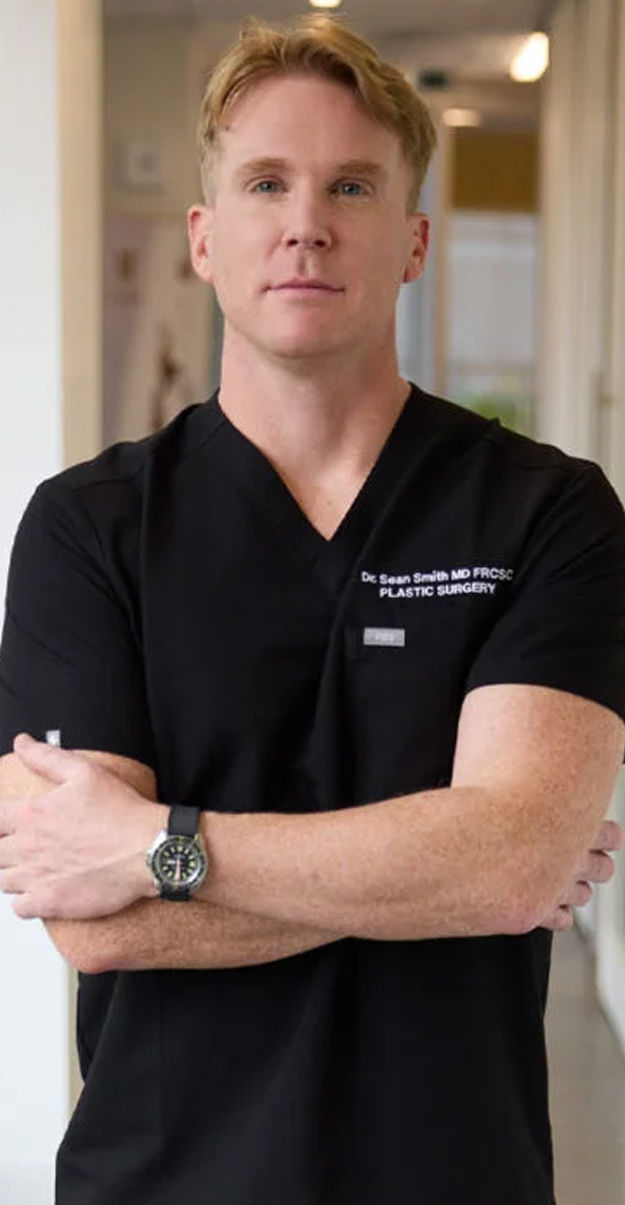
Dr. Smith
Your satisfaction involves more than a fee. When choosing a plastic surgeon for Upper Eyelid, remember that the surgeon's experience and your comfort with him or her is just as important as the final cost of the surgery.
Plastic surgery involves many choices. The first and most important is selecting a Plastic Surgeon you can trust. Plastic Surgeons such as Dr. Smith, certified by the Royal College of Physicians and Surgeons of Canada meet rigorous standards:
Board certification by Royal College of Physicians and Surgeons of Canada®
Completed five years of surgical training following medical school
Pass comprehensive oral and written exams
Complete continuing medical education, including patient safety
Perform surgery in accredited hospitals and surgical facilities
Following Dr. Smith’s Plastic Surgery residency, he completed an extra year of training, completing two additional clinical Fellowships to further his expertise in the field of Plastic Surgery. Please see his biography for more details.
Do not be confused by other official sounding boards and certifications. Be sure to choose a highly trained plastic surgeon who is board-certified by the American Board of Plastic Surgery or The Royal College of Physicians and Surgeons of Canada.
This procedural information is intended strictly for educational purposes. Only models are depicted in these procedural information pages. It is not intended to make any representations or warranties about the outcome of any procedure. It is not a substitute for a thorough, in-person consultation with Dr. Smith.

CONTACT DR. SMITH
Dr. Smith is located in Ottawa's West End. Our office features ground-level entry and offers abundant parking. Over 500 free parking spots are available.
For Ottawa appointment inquiries, please use the form.