
Breast Fat Transfer
Breast Fat Transfer: Options and Limits
Breast fat transfer uses your own fat to add a small amount of fullness or change breast shape. Dr. Smith collects this fat with liposuction.
Planning your breast fat transfer
At your Ottawa consultation, Dr. Smith will assess your breast shape, skin, and the areas that could supply fat. We will discuss whether fat transfer, implants, or a lift fits the change you want.
Healing and results
Your body absorbs some of the transferred fat during healing. The amount that remains varies. Some patients may consider another session.
Fees, recovery and risks
Your breasts and the areas that supply the fat need time to heal. We will discuss garments, pressure, and activity. Risks include infection, uneven shape, and lumps or changes that can appear on breast imaging. Your written quote will cover liposuction, fat transfer, anesthesia, facility care, and any added surgery.
Who may consider breast fat transfer?
This procedure may be appropriate for individuals who:
Notice mild to moderate volume loss in the breasts
Feel breast fullness is uneven or lacks softness
Prefer to avoid implants
Have a stable weight and adequate donor fat
Are seeking subtle enhancement rather than a significant size increase
Breast fat transfer is not intended for those seeking dramatic enlargement or a defined change in cup size.


Our surgical approach
Each breast fat transfer plan is developed as a rebalancing strategy rather than a volume-based procedure.
Fat is carefully harvested from selected areas of excess, processed, and strategically transferred to areas of volume deficiency within the breast. Placement is conservative and layered, prioritizing safety, tissue health, and long-term integration.
Overfilling is intentionally avoided to maximize the amount of grafted fat that “takes” or survives the grafting procedure. The objective is softness, balance, and a result that feels biologically and visually natural.
What this procedure may address
Breast fat transfer may help address:
Mild to moderate volume loss
Asymmetry between breasts
Upper pole softness or hollowing
Contour irregularities following prior surgery
Every surgical plan is individualized and based on anatomy, tissue quality, and long-term outcomes rather than aesthetic trends.
Frequently Asked Questions (FAQ)
A considered decision guide
Choosing how to restore or enhance breast volume is not a question of “natural versus artificial” or right versus wrong. It is a decision about anatomy, goals, tolerance for maintenance, and long-term outcomes.
This guide exists to clarify the difference between breast fat transfer and breast implants in a calm, honest way, without bias toward either option.
How we frame the decision
Every recommendation begins with three questions:
-
What kind of change is being sought, subtle restoration or structural increase?
-
What does the existing breast tissue and skin support allow?
-
What will age best over time for this individual?
Fat transfer and implants are different tools. Each is appropriate in different situations when used thoughtfully.
Breast Fat Transfer
What it is
Breast fat transfer uses your own tissue to restore softness, fullness, and balance within the breast. Fat is harvested from areas of excess, processed, and strategically transferred to areas of volume deficiency.
What fat transfer does well
Fat transfer is well-suited for:
-
Mild to moderate volume restoration
-
Improving softness and contour
-
Addressing asymmetry
-
Subtle upper pole fullness
-
Patients who prefer to avoid implants
Results are gradual and biologically integrated.
Limitations of fat transfer
Fat transfer:
-
Does not reliably create large size increases
-
Depends on the available donor fat
-
Requires acceptance that not all transferred fat survives
-
Produces more subtle, incremental change
Fat transfer is not designed for dramatic enlargement or precise size targeting.
Breast Implants
What they are
Breast implants provide structural volume and shape. They are designed to produce a predictable, defined increase in breast size.
What implants do well
Implants are well-suited for:
-
Moderate to significant size increase
-
Defined upper pole support
-
Patients with limited donor fat
-
Situations where structural support is needed
-
Those seeking more predictable volume change
Implants provide immediate and measurable change.
Considerations with implants
Implants:
-
Are medical devices that require long-term consideration
-
May require future monitoring or replacement
-
Introduce a foreign material into the body
-
Require thoughtful sizing and placement to avoid overcorrection
Implants are not inherently aggressive when selected conservatively.
Comparing the two approaches
Fat transfer and implants differ in how they behave over time.
-
Fat transfer integrates biologically and changes with the body
-
Implants maintain defined volume and shape
-
Fat transfer ages subtly
-
Implants provide structural consistency
Neither option is superior; appropriateness depends on anatomy and goals.
When combination approaches are considered
In some cases, fat transfer and implants may be combined.
This approach may be discussed when:
-
Additional softness is desired around an implant
-
Minor asymmetry requires refinement
-
Contour blending is beneficial
Combination strategies are planned conservatively and not routinely required.
How the decision is made
During consultation, we:
-
Assess breast anatomy, tissue quality, and skin support
-
Discuss desired change honestly
-
Explain what each option can and cannot achieve
-
Consider long-term maintenance and lifestyle factors
-
Recommend the approach that aligns with balance and longevity
In some cases, neither option may be recommended at the present time.
A note on restraint
More volume does not always produce better results.
Restraint protects outcomes, regardless of technique.
The goal is not to choose the “bigger” option, but the appropriate one.
Final reminder
Both fat transfer and implants can produce excellent outcomes when used thoughtfully.
The best choice is the one that respects anatomy, goals, and long-term well-being.
A private consultation provides the space to carefully explore this decision without obligation.
-


Consultation and Preparing for Surgery
During your consultation be prepared to discuss:
Your surgical goals
Medical conditions, drug allergies, and medical treatments
Current medications, vitamins, herbal supplements, alcohol, tobacco, and drug use
Previous surgeries

Dr. Smith may also:
Evaluate your general health status and any pre-existing health conditions or risk factors
Discuss your breast fat transfer options
Examine your breasts and discuss your goals
Take photographs
Recommend a course of treatment
Discuss likely outcomes of fat transfer and any risks or potential complications

Prior to surgery, you may be asked to:
Get lab testing or a medical evaluation
Take certain medications or adjust your current medications
Stop smoking
Avoid taking aspirin, anti-inflammatory drugs, and herbal supplements as they can increase bleeding
Liposuction should be performed in an accredited office-based surgical facility, licensed ambulatory surgical center, or a hospital. Be sure to arrange for someone to drive you to and from surgery and to stay with you for at least the first night following surgery. Be sure to ask questions. It's very important to ask Dr. Smith questions about liposuction.
It's natural to feel some anxiety, whether it's excitement for your anticipated new look or a bit of preoperative stress. Don't be shy about discussing these feelings with Dr. Smith.
Recovery and considerations
All surgery involves healing and a period of adjustment.
Breast fat transfer requires patience during recovery, as not all transferred fat survives. Final results evolve gradually over several months. Activity modification and post-operative guidance are essential to support optimal integration.
Recovery timelines, limitations, and expectations are clearly discussed during the consultation.


About results
Results from breast fat transfer are intended to be subtle, soft, and proportional.
The goal is to restore natural fullness and balance so the breasts feel aligned with the rest of the body.
A considered surgical experience
From consultation through recovery, care is delivered in a calm, private, and unhurried environment.
Patients are supported with honest guidance, thoughtful planning, and conservative recommendations, without pressure to pursue size beyond what is appropriate.
Moving forward
Choosing breast fat transfer is a personal decision.
A private consultation provides the time and space to explore whether autologous breast rebalancing is appropriate for you and to discuss options carefully, without obligation.
The Procedure
Fat transfer surgery may last between one to four hours, depending on the complexity of the procedure and whether an additional procedure is performed at the same time. Dr. Smith will meet you before surgery and carefully mark the areas where fat will be removed, and the areas where fat will be injected. These markings will be used as guidelines during the procedure.

Step 1
Anesthesia
Medications are administered for your comfort during the surgical procedure. The choices include local anesthesia, intravenous sedation, and general anesthesia. Dr. Smith will recommend the best choice for you.
Fat transfer may be performed under local anesthesia where only the surrounding area is numb. Alternatively, for procedures involving larger areas of the body, you may be asleep under general anesthesia. A special medicated fluid called tumescent fluid is injected into the areas that will be treated with liposuction. This fluid expands the tissues, to make it easier to remove fat cells, numbs the treatment area, and minimizes bleeding and bruising.

Step 2
Fat Harvest with liposuction
Dr. Smith will begin the procedure by using liposuction to harvest your fat. Excess fat is removed from areas of the body including the back, abdomen, thighs, and buttocks. Most body fat is located on top of muscle tissue, just beneath the skin. Liposuction works by surgically removing excess fat with a suction device, resulting in improved contours in the desired area
Liposuction is performed through small, inconspicuous incisions. First, diluted local anesthesia is infused to reduce bleeding and trauma.
Then a thin hollow tube, or cannula, is inserted through the incisions to loosen excess fat using a controlled back and forth motion. The dislodged fat is then suctioned out of the body using a surgical vacuum or syringe attached to the cannula.

Step 3
Fat transfer to the desired location
Dr. Smith will use a cannula to inject the fat cells into the desired location. Using a forward and backward motion, fat is slowly added in multiple areas until the desired volume and contour is achieved.

Step 4
Closure
The incisions may be closed with sutures or may be left open. Lastly, absorbent pads are applied to protect the incision sites as you heal.
Your improved body contour will be apparent once the swelling and fluid retention commonly experienced following liposuction subside. With continued practices of healthy diet and fitness, the loss of excess fatty tissue should be permanently maintained. However, substantial weight gain can alter the results.

Risks and Safety
The decision to have liposuction is extremely personal. You will have to decide if the benefits will achieve your goals and if the risks and potential complications are acceptable. You will be asked to sign consent forms to ensure that you fully understand the procedure and any risks and potential complications.
Dr. Smith will discuss risks such as cysts, infection, small mineral deposits called microcalcifications, and death of fat cells. You also may need to discuss options for future fat transfers as it may take more than one procedure to achieve your desired look.
The risks include:
Anesthesia risks
Bleeding
Change in skin sensation that may persist
Damage to deeper structures such as nerves, blood vessels, muscles, lungs, and abdominal organs
Fluid accumulation
Infection
Irregular contours or asymmetries
Need for revision surgery
Persistent swelling
Poor wound healing
Rippling or loose skin, worsening of cellulite
Swelling
These risks and others will be fully discussed prior to your consent. It is important that you address all your questions directly with Dr. Smith.


Rhinoplasty 5.0/5 — May 12, 2022 I highly recommend Dr. Smith for anyone considering a rhinoplasty. I am currently 8 weeks post op and I'm thrilled with my results so far. I have nothing but good things to say about Dr. Smith and his team at The Ottawa Clinic.
Breast Augmentation 5.0/5 — August 18, 2025 Dr. Smith is absolutely amazing, he is the most skilled surgeon in Ottawa and along with that he also has great bedside manner. I met a few surgeons for consults before I met Dr. Smith, for my breast augmentation. None of them were as thorough, knowledgable, kind, or positive as he was. From our first consult I knew I wanted him to be my surgeon. …
Upper and Lower Blepharoplasty 5.0/5 — November 22, 2024 Dr. Smith is an excellent surgeon and has a great personality. I had blepharoplasty ( upper and lower eyelid) and after couple of weeks it looked really good and even better now after two months. Dr Smith is knowledgeable and well skilled and make you at ease and answers all your questions and concerns. …
Deep Plane Facelift 5.0/5 — April 4, 2025 Dr. Smith is an exceptional surgeon. physician. He and his staff are professional, kind and caring. He performed a deep plane face lift for me just two weeks ago and I am already so pleased with the results. 10 out of 10 rating for Dr. Smith.
Breast Augmentation 5.0/5 — December 21, 2023 Dr. Smith is an exceptional cosmetic surgeon who has truly transformed my life through his remarkable skill and expertise. I recently underwent a breast augmentation procedure under his care, and I couldn't be more thrilled with the results. From the initial consultation to the post-operative care, Dr. Smith demonstrated the utmost professionalism and compassion. …
Abdominoplasty / Tummy Tuck 5.0/5 — October 22, 2021 I went to Dr. Sean Smith for an abdominoplasty (tummy tuck), I cannot be more thrilled with the results! From start to finish, he and his team made me feel comfortable with no pressure at all. Both the clinic and the private surgery location are clean and modern with ample free parking. …
Rhinoplasty 5.0/5 — April 1, 2023 In the summer of 2022 I met with Dr.Smith to inquire about rhinoplasty surgery. I was curious and equally nervous about proceeding. It was not until I met with Dr.Smith that I felt confident and safe in my decision to proceed. …
Mommy Makeover 5.0/5 — July 24, 2026 Choosing Dr. Sean Smith for my mommy makeover was one of the best decisions I’ve ever made. From my very first consultation, I knew I was in the right place. Dr. Smith was patient, honest, and took the time to understand exactly what I was hoping to achieve. He explained every part of the procedure thoroughly and made me feel comfortable and confident moving forward. …
Breast Augmentation 5.0/5 — April 19, 2024 I had breast augmentation with Dr. Sean Smith, and I am extremely happy with the results. After 8 weeks post-surgery, I can confidently say he is professional and his work is beyond perfect. The pain level was minimal, only 2 out of 10, and my recovery took just 5 days before I was back to work. …
Recovery After Surgery
Most fat transfer procedures are completed in outpatient surgery facilities; you should be ready to go home the same day, usually within two to four hours.
Once your procedure is completed, a compression garment or elastic bandages may cover treatment areas. These help to control swelling and compress the skin to your new body contours.
You will be given specific instructions that may include how to care for the surgical site, medications to take orally to help manage your pain for the first few days, specific concerns to look for at the surgical site or in your general health, and when to follow up with Dr. Smith.
Be sure to ask Dr. Smith specific questions about what you can expect during your individual recovery period:
Where will I be taken after my surgery is complete?
What medication will I be given or prescribed after surgery?
Will I have dressings/bandages after surgery?
How long will I wear the compression garment?
Are stitches removed? When?
When can I resume normal activity and exercise?
When do I return for follow-up care?

Results
While you will most likely notice an improvement immediately after the procedure, final results will not be apparent until one year after surgery. You should have initial satisfaction with the size and shape of the fat transfer after surgery, however much of this is due to swelling and the results may diminish over time.
Although fat cells are removed permanently during the procedure, it is important to realize that fat transfer does not prevent growth of remaining fatty tissue. Additionally, fat cells injected into the desired area may disperse from the injected area. Your results may also change if you gain or lose weight.
With realistic expectations and proper maintenance, you may enjoy the results of your fat transfer procedure for years.
Your improved body contour will be apparent when the swelling and fluid retention commonly experienced following liposuction subside.
The results of liposuction will be long lasting, provided that you maintain a stable weight and general fitness. As your body ages, it is natural to lose some firmness, but most of your improvement should be relatively permanent.
Although good results are expected from your procedure, there is no guarantee. In some situations, it may not be possible to achieve optimal results with a single surgical procedure and another surgery may be necessary.
Following Dr. Smith’s instructions is essential to the success of your surgery. It's important that the surgical incisions are not subjected to excessive force, swelling, abrasion, or motion during the time of healing. Dr. Smith will give you specific instructions on how to care for yourself.

Cost
Prices for fat transfer procedures can vary. The cost will be based on the type of procedure required to address your specific needs. Dr. Smith does offer patient financing plans, so be sure to ask.
Cost may include:
Anesthesia fees
Hospital or surgical facility costs
Medical tests (if required)
Post-surgery garments (if required)
Surgeon's fee
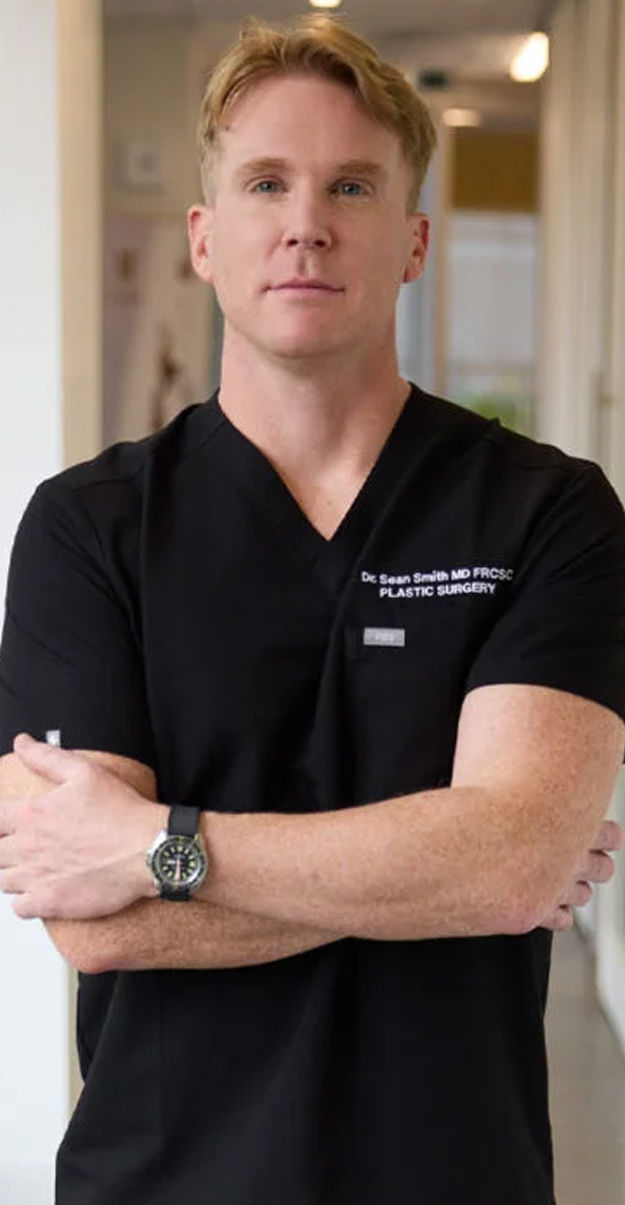
Dr. Smith
Your satisfaction involves more than a fee. When choosing a plastic surgeon for Breast Fat Transfer, remember that the surgeon's experience and your comfort with him or her is just as important as the final cost of the surgery.
Plastic surgery involves many choices. The first and most important is selecting a Plastic Surgeon you can trust. Plastic Surgeons such as Dr. Smith, certified by the Royal College of Physicians and Surgeons of Canada meet rigorous standards:
Board certification by Royal College of Physicians and Surgeons of Canada®
Completed five years of surgical training following medical school
Pass comprehensive oral and written exams
Complete continuing medical education, including patient safety
Perform surgery in accredited hospitals and surgical facilities
Following Dr. Smith’s Plastic Surgery residency, he completed an extra year of training, completing two additional clinical Fellowships to further his expertise in the field of Plastic Surgery. Please see his biography for more details.
Do not be confused by other official sounding boards and certifications. Be sure to choose a highly trained plastic surgeon who is board-certified by the American Board of Plastic Surgeons or The Royal College of Physicians and Surgeons of Canada.
This procedural information is intended strictly for educational purposes. Only models are depicted in these procedural information pages. It is not intended to make any representations or warranties about the outcome of any procedure. It is not a substitute for a thorough, in-person consultation with Dr. Smith.

CONTACT DR. SMITH
Dr. Smith is located in Ottawa's West End. Our office features ground-level entry and offers abundant parking. Over 500 free parking spots are available.
For Ottawa appointment inquiries, please use the form.